Monday, June 6, 2011

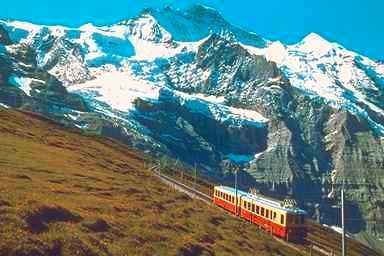
Day 8 - Interlaken; Jungfraujoch!

The Jungfraujoch is the lowest point on the mountain between Monch and jungfrau, at 3,471 meters. It is just above this location that the mountain station of Jungfraubahn is located. Jungfraujoch railway station is the highest in Europe, and the Jungfraujoch is often called the "Top of Europe" in tourist literature.

Adolf Guyer-Zeller first thought of the idea of a tunnel in 1893 and at that point he had planned to have seven stations inside the tunnel before reaching what is now the Sphinx. The building of the tunnel started on July 27, 1896 and took sixteen years to complete. The construction phase was troubled by many problems including monetary shortages, inclement weather, and mounting deaths due to construction accidents. The worst accident occurred in 1908, when thirty tons of dynamite accidentally exploded.

Once construction was halted, the tunnel reached only to the height of the Jungfraujoch, rather than the Sphinx, with only two intermediate stations. However, even in its current state, the Jungfraubahn is a significant achievement in engineering and construction, still holding the title for highest railway in Europe.

Day 7 - Interlaken

Today we move away from Italy and drive to beautiful Switzerland.
Our first stop in Switzerland is the resort town of Interlaken.
Until 1891, Interlaken was known as Aamuhle. The convent of the Augustinian Canons was built in 1130 and lasted until 1528. Previously, printing, textiles, and to a smaller extent watchmaking were also of importance, but today tourism is the most significant source of income. Interlaken is one of the oldest tourist resorts in Switzerland, and it remains one of the most popular.

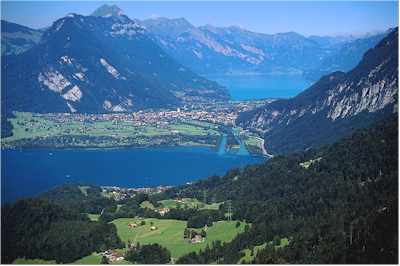
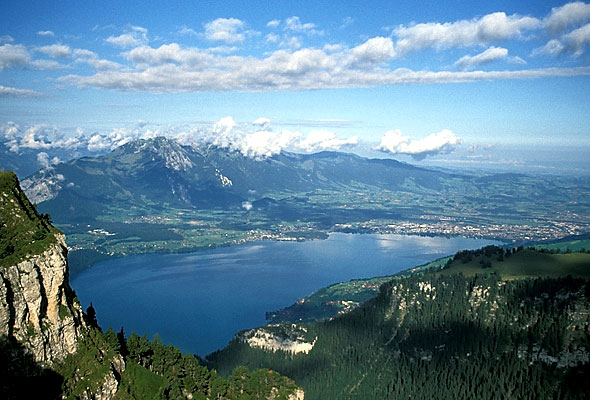
Interlaken is situated at the base of the Jungfrau Mountains between Lake Brienz and Lake Thun.

Lake Thun's approximately 2,500 square kilometer large catchment area frequently causes local flooding after heavy rainfall. This occurs because the river Aar, which drains the lake Thun, has only limited capacity to handle the excess runoff. The lake is fed by water from Lake Brienz to the southeast, which lies 6 meters higher than Lake Thun, and various streams int he Oberland, including the Kander. Lake Thun was created after the last ice age andw as originally part of Lake Brienz. The historic combined lake is called Wendelsee by geologists and historians.

Fishing os important enough to keep a handful of professional fishers employed. Since 1835, passenger ships have also operated on the lake. There are ten passenger ships in total, operated by the local railway company.

Following WWII and up till 1964, the Swiss Government disposed of unused munitions into Lake Thun. The quality of munitions dumped is reported to be from 3,000 to more than 9,020 tons.


Lake Brienz took its name from the village of Brienz on its northern shore. The shores are steep, and there is almost no shallow water in the entire lake.

Lake Brienz is the first river in which the river Aar expands. When it leaves Lake Brienz, it soon joins Lake Thun. The lake lies in a deep hollow between the village of Brienz on the east and Bonigen on the west. Its length is about 14 kilometers, its width 2.8 kilometers, and its maximum depth 260 meters. On the south shore are the Giessbach Falls and the hamlet of Iseltwald. On the north shore are a few small villages.

The character of the lake is gloomy and sad as compared with its neighbour, that of Thun. It is poor in nutrients, and consequently fishing is not very important. Like Thun, passenger ships are also operated on this lake.

Day 6 - Venice; Milan

We commence with a visit to Milan's famous Gothic Cathedral.
This elaborate cathedral took six centuries to complete! It is the fourth largest in the world and the largest in Italy.
It was finally completed in the 19th century, when Napoleon Bonaparte ordered its completion. In his enthusiasm, he assured that all expenses would fall on the French treasurer, who would reimburse the Fabbrica for the real estate if it had to sell. Even though this reimbursement was never paid, it still meant that finally, within seven years, the cathedral was finished. The new architect Francesco Soave largely followed the original plan, but added some neo-Gothic details to the upper windows. As a form of thanksgiving, a statue of Napoleon was placed at the top of one of the spires.

Our next stop is the La Scala Opera House.
La Scala is a renowned opera house, originally known as the New Royal-Ducal Theatre at La Scala. Most of Italy's great operatic artists have appeared at La Scala during the past 200 years. Today, the theatre is still recognized as one of the leading ballet and opera theaters in the world.
La Scala was originally illuminated with eighty-four oil lamps and another thousand in the rest of the theater. To prevent the risk of fire, several rooms were filled with hundreds of water buckets. In time, oil lamps were replaced by gas lamps, these in turn were replaced by electric lights in 1883.
The original structure was renovated on 1907, when it was given its current layout with 2,800 seats. In 1943, during WWII, La Scala was severely damaged by bombing. It was rebuilt and reopened on May 11, 1946, with a memorable concert conducted by Arturo Toscanini - twice La Scala's principal conductor and an associate of the composers Giuseppe Verdi and Giacomo Puccini.
La Scala hosted the prima of many famous operas, and had a special relationship to with Verdi. For several years, however, Verdi did not allow his work to be played here, as some of his music had been modified (he said "corrupted") by the orchestra. This dispute originated in a disagreement over the production of his Giovanna d'Arco in 1845; however the composer later conducted his Requiem there on May 25, 1874, and in 1886 announced that La Scala would host the premiere of his opera Otello. The premiere of his last opera, Falstaff, was also given in the theater.
In 1982, the Filharmonica della Scala was established, drawing its members from the larger pool of musicians that comprise the Orchestra della Scala.


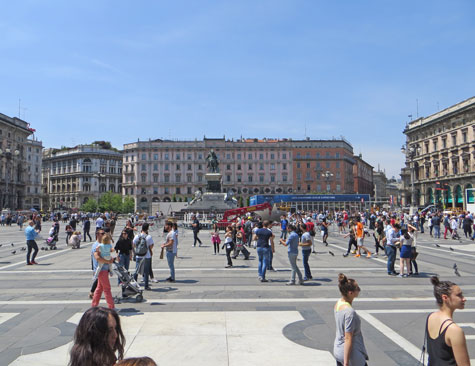
The Piazza del Duomo is named after, and dominated by the Milan Cathedral. The piazza marks the center of the city, both geographically and because of its importance from an artistic, cultural, and social point of view. Rectangular in shape and with an overall area of 183 square feet, the piazza contains some of the most important buildings in Milan, as well as some of the most prestigious commercial activities. It is by far the foremost tourist attraction of the city.
While the piazza was originally created in the 14th century and has been developing ever since, its overall plan, in its current form, is largely due to the architect Giuseppe Mengoni, and dates back to second half of the 19th century. The monumental buildings that mark its sides, with the main exception of the Duomo and the Royal Palace, were introduced by Mengoni's design; the most notable of Mengoni's additions to the piazza is the Galleria Vittorio Emanuele II arcade.

The Galleria Vittorio Emanuele II, or Gallery Victor Emmanuel II, is a covered double arcade formed of two glass-vaulted arcades at right angles intersecting in an octagon. Named after the first king of united Italy, it was originally designed in 1861 and built by Giuseppe Mengoni between 1865 and 1877.
The street is covered over by an arching glass and cast iron roof, a popular design for 19th century arcades such as the Burlington Arcade, London, which was the prototype for larger glazed shopping arcades, beginning with the Saint-Hubert Gallery in Brussels, the Passazh in St. Petersburg, the Galleria Umberto I in Naples, and the Budapest Galleria.
The central octagonal space is topped with a glass dome. The Milanese Galleria was larger in scale than its predecessors and was an important step int he evolution of the modern glazed and enclosed shopping mall, of which it was the direct progenitor. It has inspired the use of the term galleria for many other shopping arcades and malls. The use of the iron structure has inspired also the Eiffel Tower, in Paris.
The Galleria connects two of Milan's most famous landmarks - the Duomo and the La Scala Opera House, but the Galleria is a landmark in its own right. It is often called the "living room of Milan", enhanced by the elegance of some of Milan's finest stores.
Day 5 - Tuscany Region; Venice

Today we depart for Venice!


St. Mark's Square - the principal public square of Venice, where it is generally simply known as "the Piazza". The Piazzeta, the "little Piazza", is an extension of the Piazza. These two spaces together form the social, religious, and political center of Venice.
A remark, often attributed to Napoleon, calls the Piazza the "drawing room of Europe". It is one of the few great urban spaces where human voices prevail over the sounds of motorized traffic.

We will then see the Clock Tower and the Bridge of Sighs (above).
The enclosed bridge is made of limestone and has windows with stone bars. It passes over the Rio di Palazzo and connects the old prisons to the interrogation rooms in Doge's Palace. It was designed by Antoni Contino and built in 1602. The view from the Bridge of Sighs was the last view convicts would have before their imprisonment. The bridge's name, given by Lord Byron, comes from the suggestion that prisoners would sigh at their final view of beautiful Venice through the windows before being taken down to their cells.

We then proceed to Doge's Palace, the residence of the Doge of Venice, the supreme authority of the Republic of Venice.
The current palace was largely constructed from 1309 to 1424, designed perhaps by Filippo Calendario. It replaced earlier fortified buildings of which relatively little is known. The palace was badly damaged by a fire on December 20, 1577. In the subsequent rebuilding work, it was decided to respect the original Gothic style, despite the submission of a neo-classical alternative design by the influential Renaissance architect Andrea Palladio. However, there are some classical features - for example, since the 16th century, the palace has been linked to the prison by the Bridge of Sighs.
The building is preserved as a museum. Inside are housed paintings by Tintoretto and Paolo Veronese.

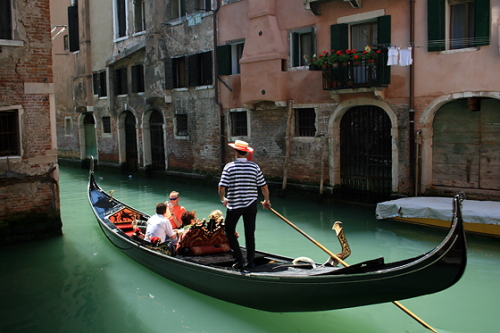
Our fifth day in Europe ends here, but if there is some free time, we get to go on a gondola ride too! :)

Day 4 - Florence; Pisa

We will visit the Square of Miracles with the Leaning Tower, Cathedral, Baptistery and Monumental Cemetery.
The Leaning Tower of Pisa is the campanile - free-standing bell tower - of the cathedral of the Italian city of Pisa. It is situated behind the cathedral and is the third oldest structure in Pisa's Cathedral Square.

Brunelleschi's Dome, Florence

The eight lower panels of the Door of Paradise depict the eight virtues of hope, faith, charity, humility, fortitude, temperance, justice, and prudence. The bronze casting was done by Leonardo d'Avanzano, widely recognized as one of the best bronze smiths in Europe.

We will also be visiting the Piazza Signoria, the Ponte Vecchio, and the Santa Croce Church.

Day 3 - Rome; Siena; Tuscany

The Piazza del Campo is the principle public space of the historic center of Siena, Tuscany, and is one of Europe's greatest medieval squares. It is renowned worldwide for its beauty and architectural integrity. Twice a year, the famous horse race Palio di Siena is held around the edges of the piazza. (see picture above)

We will then view the Marble Cathedral before procedding to the scenic region of Florence, the capital of the Renaissance.

Friday, June 3, 2011

Day 2 - Vatican City and Rome

Our first stop will be Vatican City!
Vatican City is a landlocked, sovereign state which is entirely surrounded by Rome.
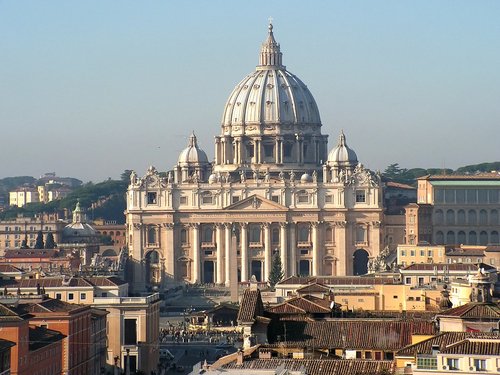
We will be stopping by St. Peter's Basilica, which has the largest interior of any church in the world. It is regarded as one of the holiest sites by Roman Catholics, and is a popular site for Catholic pilgrimages.
We will then proceed to the Colosseum in Rome, formerly known as the Flavian Amphitheatre. It is considered one of the greatest products of Roman engineering and architecture.
Capable of seating 50,000 spectators, the Colosseum was used for gladiatorial contests and public spectacles like re-enacted sea battles, hunts, executions, and dramas.
Over the years it has been partially ruined by earthquakes, but it still remains an iconic symbol of Rome.
We will also see the Trevi Fountain. Standing at 26 metres high and 20 metres wide, it is the largest Baroque fountain in the city and one of the most famous in the world.
The Spanish Steps are also found in Rome, Italy. These steps climb a steep slope between the Piazza di Spagna at the base and the Piazza Trinita dei Monti.
The 138 steps are commonly used on special occasions for several purposes. During the Christmas period a 19th-century crib is displayed on the stairs, and it is also used as a venue for a flower market. People ate forbidden to stop by the steps for their meals, but these steps are still almost always crowded.